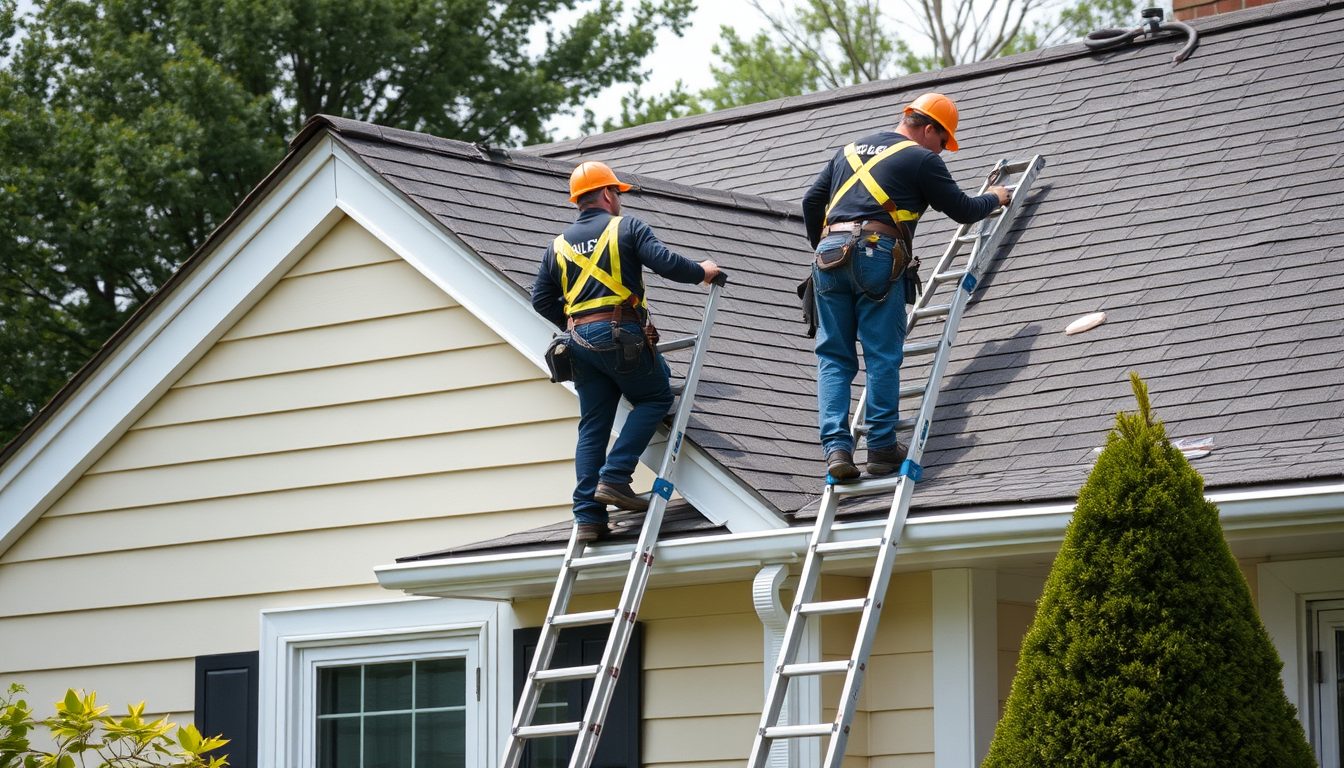
Feeding Hills and the flatter Agawam farmhouses
The Feeding Hills side of Agawam still has a good number of older farmhouses on larger lots, with steep, simple gable roofs that were easy to build right the first time and easy to neglect for decades after. Closer to Route 57 and toward Six Flags, the housing gets denser and newer, with ranches and split-levels from the sixties and seventies now on their second or third roof. The farmhouses tend to fail at the ridge where old boards have twisted, while the newer ranches fail at the low-slope additions tacked onto the back of the house.
Agawam sits low and close to the rivers, which means the ground around these houses holds moisture longer after a storm than it does up in the hills, and that dampness works its way into fascia and sill areas that never quite get to dry out between rains.
Ludlow's mill housing near the old complex
Ludlow grew up around its mill, and the housing closest to that old complex still shows it: tight rows of two-family and three-family homes with steep, narrow roofs and small porch additions tucked onto the back. Those porch roofs are almost always the first thing to leak, since they were built cheaply and quickly to house mill workers, never meant to last a century. Farther out toward the newer streets, the roofs are wider and simpler, mostly single-family capes and colonials with straightforward pitches.
I see a lot of undersized ventilation in the older Ludlow triple-deckers specifically, because the original builders never planned for insulation depth at all, so even a roof replaced within the last ten years can still be running warm in the attic and forming ice at the eave every winter.
Wilbraham's hills change the weather math
Wilbraham sits noticeably higher and colder than Springfield, and the difference shows up on roofs before it shows up anywhere else. Houses off Stony Hill Road and up toward Glendale Road catch more wind and hold snow longer into the spring than anything down in the valley floor, which means ice dams there can run later in the season than a homeowner expects. The building stock leans newer overall, colonials and larger capes on wooded lots, but the exposure more than makes up for the newer construction.
Wind is the bigger issue up here. I see more lifted and missing shingles after a fall storm in Wilbraham than in flatter towns nearby, simply because there is nothing between those hilltop roofs and the weather coming through.
East Longmeadow and its brownstone legacy
East Longmeadow's old quarries once supplied brownstone to builders well outside the valley, and the town still carries some of that older, heavier housing near the center, close to Somers Road heading down toward the Connecticut line. Those older homes often carry the same deep cornices and built-in gutters I see in Longmeadow itself, which means the carpentry side of a roof problem shows up here just as often as the shingles do.
Farther from the center the housing is younger, and the roofing problems get simpler: standard architectural shingle failures, the occasional storm-damaged ridge, and ventilation upgrades on homes built before energy codes tightened up.
Why I keep all four on the same loop
None of these four towns is large enough on its own to fill a week, but strung together along the roads that connect them, they make a route I can run efficiently without losing the local knowledge that makes a fast, accurate inspection possible. Knowing which town tends to fail at the ridge and which one fails at the eave means I show up already looking in the right place, and that saves time on every single call.